

The budget couples set in month one is rarely the amount they ultimately spend by month twelve. It’s not uncommon for wedding budgets in NJ and NY to exceed the original plan by 15 to 30 percent, often because of a handful of overlooked expenses. Sometimes more. Almost always because of the same five line items that nobody warned the couple about.
This is not a guilt-trip guide. It is a working frame for wedding budget planning that has refined through planning weddings across New Jersey and New York. We will show the numbers, the categories that quietly explode, and what to do when the math is not adding up.
What a Wedding Actually Costs in NJ and NY
The market matters. A 120-guest wedding in central New Jersey costs differently from the same wedding in upstate New York, which costs differently from a Manhattan rooftop. Rough ranges from the 2025-2026 cycle for a 120-guest wedding:
1. Central / South NJ: $45,000 to $85,000
2. North NJ / suburban NY: $65,000 to $120,000
3. NYC five boroughs: $90,000 to $200,000+
4. Long Island and Hudson Valley: $60,000 to $150,000
Couples often anchor on national average numbers ($35,000 in some surveys). For NJ and NY specifically, those numbers are out of date. For many full-service Saturday weddings in NJ and NY, a realistic starting point in 2026 is closer to $50,000.
This is the conversation to have before any vendor shopping starts.
How to Set the Budget
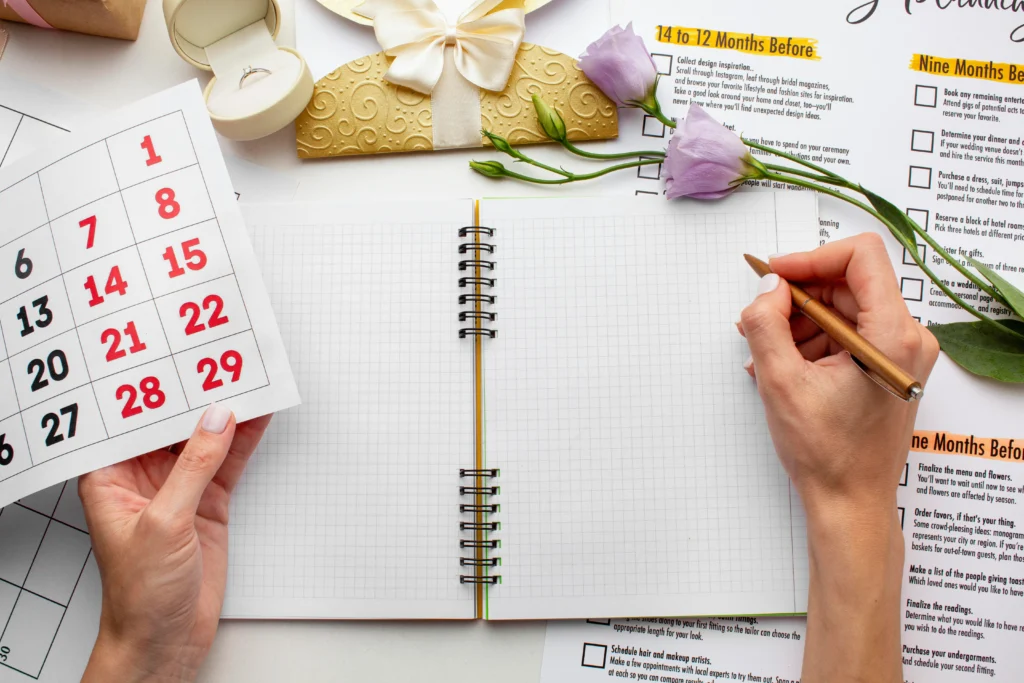
A working wedding budget is built from two directions at once. Top-down (what can we spend) and bottom-up (what does it actually cost). The number you commit to is where the two meet.
Step 1: The Top-Down Number
Three sources usually fund a wedding:
1. The couple’s own savings
2. Family contribution from one or both sides
3. A short-term financing top-up (rarely advisable but sometimes used)
Have the family-contribution conversation early. Awkward in month 11 is far better than catastrophic in month 6. Get the number. Confirm whether it is a gift or a loan.
Step 2: The Bottom-Up Budget Breakdown
A 120-guest wedding in NJ or NY breaks down approximately like this:
| Category | % of total budget | Notes |
| Venue + catering | 40-50% | The single biggest line |
| Photography + videography | 10-12% | Booked a year out |
| Florals + decor | 8-12% | Where overruns hide |
| Music (DJ or band) | 5-8% | Band is 2–3× the cost of a DJ. |
| Attire (dress, suits, alterations) | 6-10% | Includes accessories |
| Stationery (save-the-dates, invites, signage) | 2-4% | Custom = more |
| Hair + makeup | 2-4% | Bridal party adds up |
| Officiant + ceremony | 1-2% | Religious or civil |
| Transportation | 1-3% | Shuttle, limo, getaway |
| Wedding cake + sweets | 1-3% | Per slice pricing |
| Wedding planner | 8-15% | Full vs partial vs day-of |
| Gifts + favors | 2-3% | Welcome bags, thank-yous |
| Contingency | 5-10% | The line couples skip |
The contingency line is the one nobody adds. It is also the line that saves the budget when something inevitably runs over.
Where Wedding Budgets Quietly Explode
Five categories where overruns happen most often, based on what we see at White Wave Events:
1. Florals and decor. The Pinterest aesthetic looks beautiful and costs three times what couples assume. Statement installations, such as hanging florals or full floral arches, can easily cost $8,000 or more.
2. Guest count creep. Adding 20 guests to a 100-guest wedding can increase the overall budget significantly because food, beverages, rentals, stationery, and favors all scale with guest count.
3. Bridal alterations. Brides budget for the dress price. The alterations often add $400 to $1,500 on top.
4. Welcome events and rehearsal dinners. These extra events can add a significant amount to the overall budget, especially when hosting a large rehearsal dinner or welcome event.
5. Tax, service charges, and gratuity. Many vendor quotes exclude these. Depending on the venue and vendor, taxes, service charges, and gratuities can add roughly 20–25% to the quoted price.
Each of these is preventable with a line in the budget. Each becomes painful if missing.
How to Set Allocations That Hold
Three principles that hold up across most NJ and NY weddings:
1. Allocate by your priorities, not by template. If photography matters more to you, take from somewhere else (smaller floral, shorter band). The template above is a starting point, not a rule.
2. Always include the 5-10 percent contingency. Not a slush fund. A real line you protect. It will get used.
3. Build in the tax + gratuity multiplier. Whatever the venue quotes, mentally add 22 percent. That is closer to your actual outflow.
Budgets built around these three principles are much more likely to stay on track. A budget without them slips by month four.
The Sticking-to-It Practices
Setting a budget is the easy part. Sticking to it is where most couples break. Five practices that hold up:
1. One weekly budget review with both partners. Not separate spreadsheets. One. Together. 30 minutes on a Sunday.
2. Every vendor invoice goes into the master tracker the same day. Not later. Not next week. The same day. Delayed tracking is what creates budget surprises later.
3. Decisions over $500 get a 24-hour pause. Sleep on it. The vendor is not going anywhere overnight.
4. One person handles all vendor payments. Splitting the role across partners doubles the chance of missing a confirmation or paying twice.
5. Quarterly recalibration. Every three months, look at where you are versus where you projected. Adjust forward if needed, not at month 11 when no adjustment is possible.
These five together are the difference between a wedding budget panning that holds and one that becomes an unnecessary source of financial stress.
When the Budget Is Not Working
Most couples reach a moment around month 6 where the budget feels too tight. Two paths from there:
Path 1: Cut Where It Matters Least to You
Pick the two categories that you both care about most. Protect those. Cut from the others. This is a common approach many experienced wedding planners in NJ recommend because it protects the parts of the day that matter most to you.
Examples of category cuts that hurt less than couples expect:
1. Live band → DJ (saves $5,000 to $15,000)
2. Two photographers → one (saves $2,000 to $4,000)
3. Statement floral installation → simpler arrangements (saves $5,000 to $10,000)
4. Custom invites → upscale templates (saves $1,500 to $3,000)
5. Wedding cake → dessert bar (often saves $1,000+)
Path 2: Reduce Guest Count
The single biggest budget lever is the guest list. Cutting 20 guests from a 120-guest wedding can save thousands of dollars, depending on your venue and catering costs.
This conversation is harder than the category cuts because it involves family politics. It is also where the biggest savings live.
Working With a Wedding Planner to Manage Your Budget
A wedding planner adds value in budget planning specifically when:
1. The couple has never built a budget at this scale
2. Two families are contributing and the conversations are complex
3. The venue is in a different state or country (NJ couples planning in upstate NY, for example)
4. The budget feels too tight from the start and needs realistic recalibration
5. Either partner has limited time to manage the line items
Final Thoughts
Wedding budget planning is not the romantic part of wedding planning. It is the part that lets the romantic parts actually happen. The couples who finish their wedding without budget regret are the couples who treated the budget as a working document for 12 months, not a one-time number set in month one.
Set the budget honestly. Build in the contingency. Track weekly. Review quarterly. Cut deliberately when needed.
The wedding you can afford is more enjoyable than the wedding you cannot.
Planning your wedding in New Jersey or New York?
Book a free consultation with White Wave Events and build a realistic wedding budget & planning tailored to your date and vision.
FAQ
Q1. What percentage of my wedding budget should go to the venue and catering?
A. Venue and catering usually make up 40-50% of the total wedding budget, the largest expense for most couples.
Q2. How much contingency should I include in my wedding budget?
A. Reserve 5–10% of your total budget to use as a contingency fund. This is for any unexpected costs, upgrades or last minute changes.
Q3. What wedding expenses do couples commonly forget?
A. Dress alterations, taxes and service charges, gratuities, rehearsal dinners or welcome events, and décor upgrades are often forgotten costs.
Q4. What’s the best way to stay on budget while planning a wedding?
A. Track every expense, review your budget weekly, include taxes and gratuities from the start, and wait 24 hours before making any major purchases.
Q4. How can I reduce my wedding budget without sacrificing the experience?
A. Concentrate on your highest priorities and cut costs elsewhere by paring down the guest list, selecting a DJ over a live band, simplifying floral arrangements or selecting semi-custom invitations.